Bridge Officer Seating 101
Every Bridge Officer seat, on your ship and on your Away Team, is defined by two things: a rank and a specialization. Both determine which abilities you're allowed to slot there.
Rank determines how many ability slots you get
A seat's rank is Ensign, Lieutenant, Lt. Commander, or Commander, and it sets how many ability slots that seat has: Ensign gets one, Lieutenant two, Lt. Commander three, and Commander four. These are cumulative slots at increasing ranks within the same seat, not four separate seats.
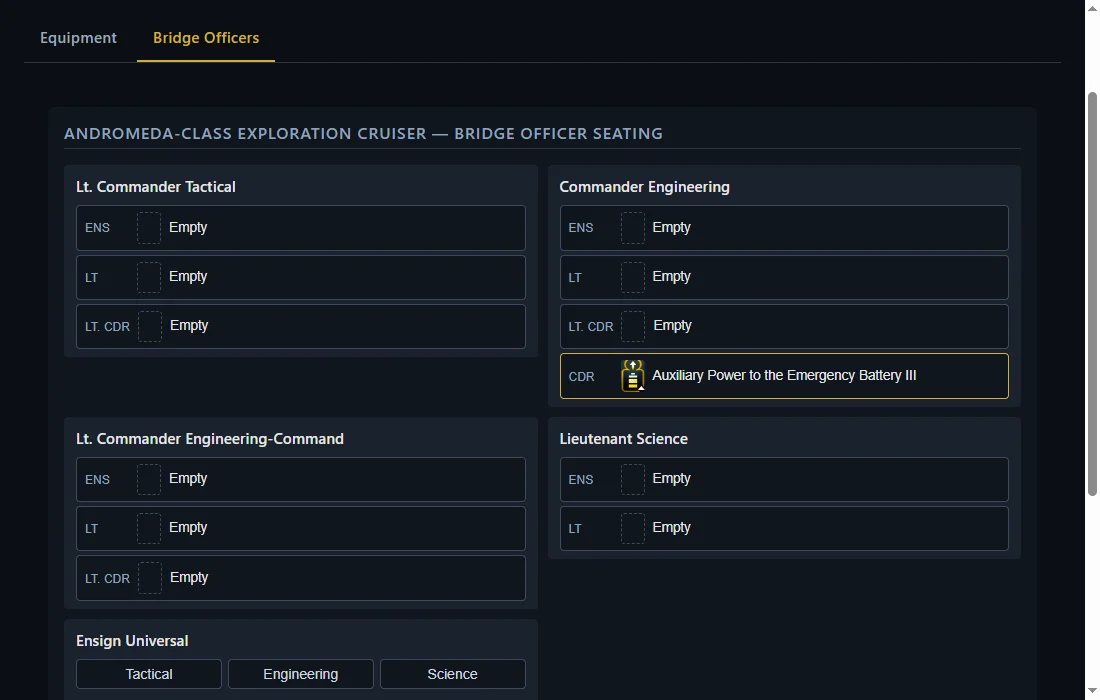
Counting the seats in that screenshot: 3 + 4 + 3 + 2 + 1 gives 13 ability slots across five seats, and the Commander Engineering seat alone accounts for four of them.
An ability also has its own minimum rank. The higher above that minimum you slot it, the stronger version you get, up to a cap of III. An ability with an Ensign minimum slotted into a Commander seat's fourth slot resolves to its strongest (III) version; the same ability in an Ensign slot resolves to its weakest (I).
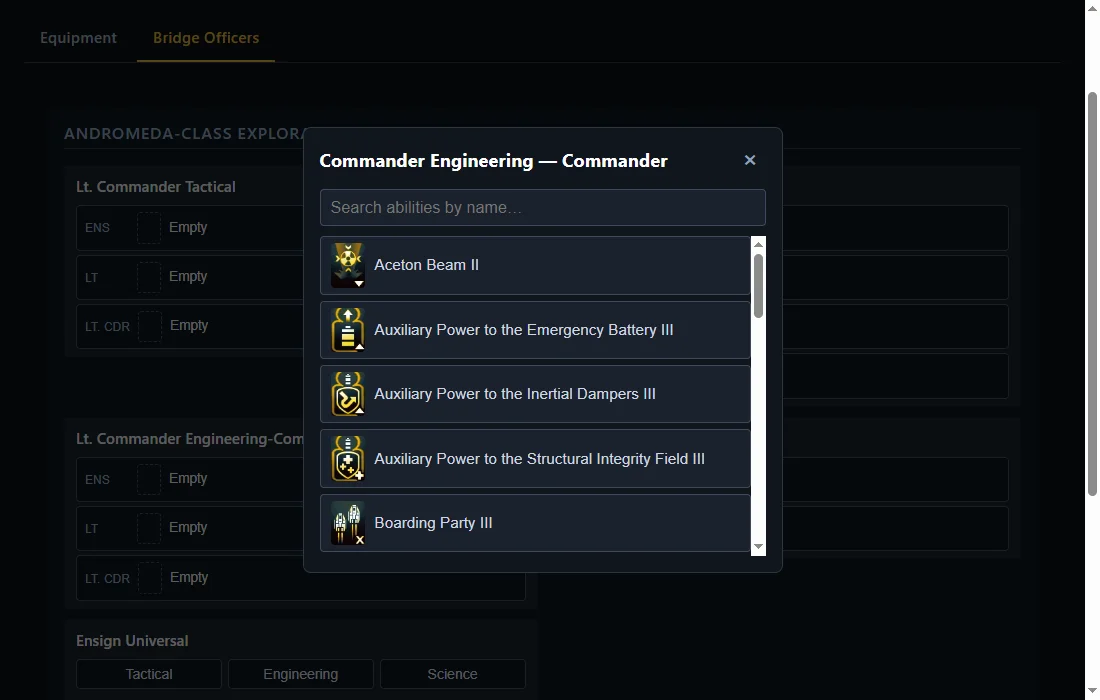
Specialization determines which abilities are even eligible
A seat's specialization, Tactical, Engineering, Science, Command, Intelligence, Pilot, Temporal, or Miracle Worker, limits the ability list to that specialization only. A hybrid seat (for example, an Engineering-Intelligence seat) merges both specializations' ability lists together, so you can pick from either.
A Universal seat can take an officer of any of the three main careers, Tactical, Engineering, or Science, but only one at a time. Pick the officer's career first; the ability list narrows to match once you do. Changing a Universal seat's assigned career clears whatever abilities were already equipped there, since they're no longer valid for the new career.
Away Team officers work the same way, on the ground
Your four Away Team officers use the identical rank and ability-slot system as starship seats, Ensign through Commander. The difference is what determines their specialization: instead of a fixed ship seat, you assign each officer a career directly, plus an optional further specialization, and their available ground abilities follow from that assignment. Changing an officer's career clears their equipped abilities too, for the same reason a Universal seat's does.
Putting it together
When you're deciding who to seat where: check the seat's specialization first to see what's even on the table, then its rank to see how strong an ability you can afford to put there. A Commander seat is worth reserving for whichever ability matters most to your build, since it's the only slot that can push that ability to its full strength.
Building your first character? See Getting Started: Your First Build. More questions? See the FAQ.