Bridge Officer Synergies: Choosing Abilities for Tactical, Engineering, and Science Seats
A ship's bridge officer seats are where most of a build's active power lives. Two builds can carry identical weapons and consoles and still perform very differently because of which abilities sit in which seats. The trick is not finding the best individual ability. It is choosing abilities that support each other and do not compete for the same cooldown. This guide walks through the standard package for each career and the synergies behind it, using the rules as they stand in Season 37 (September 2026).
Start with how many good slots you have
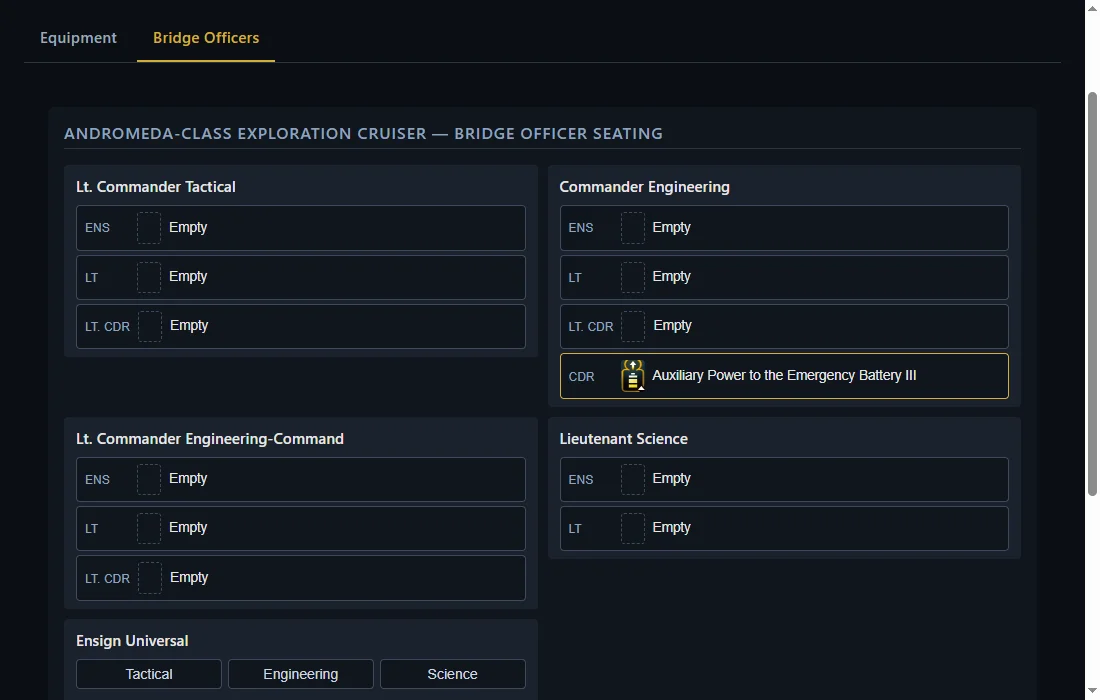
Before choosing abilities, count your slots. Each seat has one slot per rank, from Ensign up to the seat's own rank, and the version of an ability you get depends on the gap between the slot and the ability's own minimum rank, capped at III. An ability with an Ensign minimum is version I in an Ensign slot, II in a Lieutenant slot, and III in a Lieutenant Commander or Commander slot. The full rule is laid out in Bridge Officer Seating 101.
The Tactical package
Tactical seats carry the damage. The standard contents, drawn from the energy, torpedo, and exotic builds published by the STO BETTER community, are:
- One firing mode at the highest rank: Beams: Fire at Will or Overload, or Cannons: Rapid Fire or Scatter Volley for cannons.
- Attack Pattern Beta at the highest remaining rank, which marks targets and reduces their resistance.
- Torpedoes: Spread or High Yield if you carry torpedoes.
- Kemocite-Laced Weaponry, often used as a filler for damage.
- Tactical Team at rank I, which provides little offense but redistributes your shields.
The synergy to watch is the shared cooldown. Beam abilities share a 15 second category cooldown with each other, and so do torpedo abilities, so stacking several firing modes gives you no benefit and can only get in each other's way. Pick one.
The Engineering package
Engineering seats keep the ship powered and alive. Emergency Power to Weapons is close to mandatory for a damage build, and Emergency Power to Engines commonly fills another slot. Then choose a survival tool: Auxiliary Power to the Structural Integrity Field for hull, Reverse Shield Polarity for a strong shield response, or Engineering Team at rank I for a cheap heal. The other big decision is cooldown strategy. If you use Auxiliary Power to the Emergency Battery with Technician duty officers, engineering seats hold it. The comparison with Photonic Officer is worked through in Cooldown Reduction Mechanics.
The Science package
Science seats depend on the build. On an energy or torpedo ship they are usually support: Photonic Officer for cooldowns, Hazard Emitters to remove damage over time effects, Science Team for healing, or Transfer Shield Strength. On an exotic ship they are the damage. Gravity Well III sits in the Commander seat, Photonic Officer II in a Lieutenant Commander seat, and the secondary deflector triggers, Destabilizing Resonance Beam, Tyken's Rift, and Charged Particle Burst, fill the rest, as described in Exotic Damage (Science) Builds Explained.
Synergies real builds rely on
The abilities above only become a build when they link up. A few links are worth knowing by name.
- Firing mode and torpedo spread. With the Entwined Tactical Matrices trait, activating Fire at Will or Scatter Volley makes your next torpedo attack a Spread, and using Spread gives you the firing modes in return. The Arbiter build published by STO BETTER fires one manual Torpedoes: Spread roughly every 10 seconds to keep Fire at Will up, using a rank I Spread in a low slot.
- Photonic Officer and Technician duty officers. The same build runs Photonic Officer at rank I, the Calm Before the Storm trait, and two Technician duty officers, and skips Auxiliary Power to the Emergency Battery entirely.
- Concentrate Firepower and High Yield. A marked target hands out free High Yield I and resets torpedo cooldowns, so torpedo builds treat the two as a single unit. Concentrate Firepower III needs a Lieutenant Commander Command slot, and a lower rank copy overwrites a higher one, so use just one.
- Gravity Well and anomaly traits. Spore-Infused Anomalies makes every Science or Intelligence ability trigger damage from your anomalies, so an exotic ship keeps science abilities firing as often as it can.
Building a package that fits your ship
Work from the top down. Decide the damage type, then the firing mode and cooldown strategy, then fill the remaining slots with abilities that do not share a category cooldown with what you already have. Check that every ability you want is actually available at your ship's rank and specialization, because a Commander in a Lieutenant seat only uses Ensign and Lieutenant abilities. You can test a full seating plan without spending anything in the Build Planner, which shows each ability's version for the slot it is in. Then record a run with the /CombatLog command to see how it behaves in play.